Problem 2
Escape Velocities and Cosmic Velocities: A Deep Dive into Celestial Mechanics
Motivation
As we venture further into the cosmos, understanding how to overcome gravitational forces becomes a fundamental challenge in space exploration. From placing satellites into orbit to launching interstellar probes, we rely on three critical velocity thresholds: the first, second, and third cosmic velocities. These velocities not only define the boundaries of orbital mechanics but also represent the minimum energy requirements for achieving space travel objectives.
1. Definitions and Physical Meaning
First Cosmic Velocity (Orbital Velocity)
The first cosmic velocity is the minimum horizontal speed an object must have to maintain a circular orbit just above a planet’s surface without falling back due to gravity.
- It ensures that the centrifugal force due to the orbital motion balances gravitational attraction.
- Formula:
\(v_1 = \sqrt\frac{GM}{R}\)
Where: - \(G\) = gravitational constant \(\approx 6.674 \times 10^{-11} \, \text{m}^3/\text{kg s}^2\) - \(M\) = mass of the celestial body - \(R\) = radius from the center of mass
Second Cosmic Velocity (Escape Velocity)
The second cosmic velocity is the minimum speed needed for an object to escape the gravitational pull of a celestial body without further propulsion.
- At this speed, kinetic energy equals the gravitational potential energy in magnitude.
\(v_2 = \sqrt{\frac{2GM}{R}} = \sqrt{2} \cdot v_1\)
Third Cosmic Velocity (Solar System Escape)
The third cosmic velocity is the speed required to leave the gravitational influence of the Sun from Earth’s orbit. It’s the combination of Earth's escape velocity and the Sun’s gravitational potential at Earth's orbital distance.
\(v_3 = \sqrt{v_{escape,Sun}^2 + v_2^2}\)
This velocity is essential for interstellar probes like Voyager 1, Voyager 2, and New Horizons.
2. Mathematical Derivation of Cosmic Velocities
Potential Energy and Kinetic Energy Basics
- Gravitational Potential Energy:
\(U = -\frac{GMm}{R}\)
- Kinetic Energy:
\(K = \frac{1}{2}mv^2\)
a) Deriving First Cosmic Velocity:
Equating gravitational force to centripetal force:
\(\frac{GMm}{R^2} = \frac{mv^2}{R} \Rightarrow v_1 = \sqrt{\frac{GM}{R}}\)
b) Deriving Second Cosmic Velocity:
Set kinetic energy equal to the absolute value of gravitational potential energy:
\(\frac{1}{2}mv^2 = \frac{GMm}{R} \Rightarrow v_2 = \sqrt{\frac{2GM}{R}}\)
c) Deriving Third Cosmic Velocity:
We calculate escape velocity from the Sun’s gravity at the Earth’s orbital radius:
\(v_{escape,Sun} = \sqrt{\frac{2GM_{\odot}}{R_{\text{Earth-Sun}}}} \Rightarrow v_3 = \sqrt{v_{escape,Sun}^2 + v_2^2}\)
3. Python Code for Calculation and Visualization
4. Applications in Space Exploration
1️ First Cosmic Velocity:
Used for orbital insertion. This is how: - Satellites are placed into Low Earth Orbit (LEO). - The International Space Station (ISS) stays in orbit. - Communications, Earth observation, and GPS satellites operate.
2️ Second Cosmic Velocity:
Used for planetary missions: - Sending missions to Moon, Mars, and beyond. - Escaping the gravitational pull of planets.
Examples: - Apollo missions leaving Earth for the Moon. - Perseverance rover to Mars.
3️ Third Cosmic Velocity:
Used for interstellar travel: - Probes like Voyager 1 & 2, New Horizons leave the Solar System. - Requires gravity assists or high-efficiency propulsion systems.
5. Additional Factors Affecting Escape Velocity
- Atmospheric Drag: On planets with atmospheres, more energy is needed to overcome friction.
- Rotation of the Planet: Launching near the equator helps, as the rotational speed adds to the spacecraft’s velocity.
- Altitude: The higher the starting point, the lower the escape velocity required.
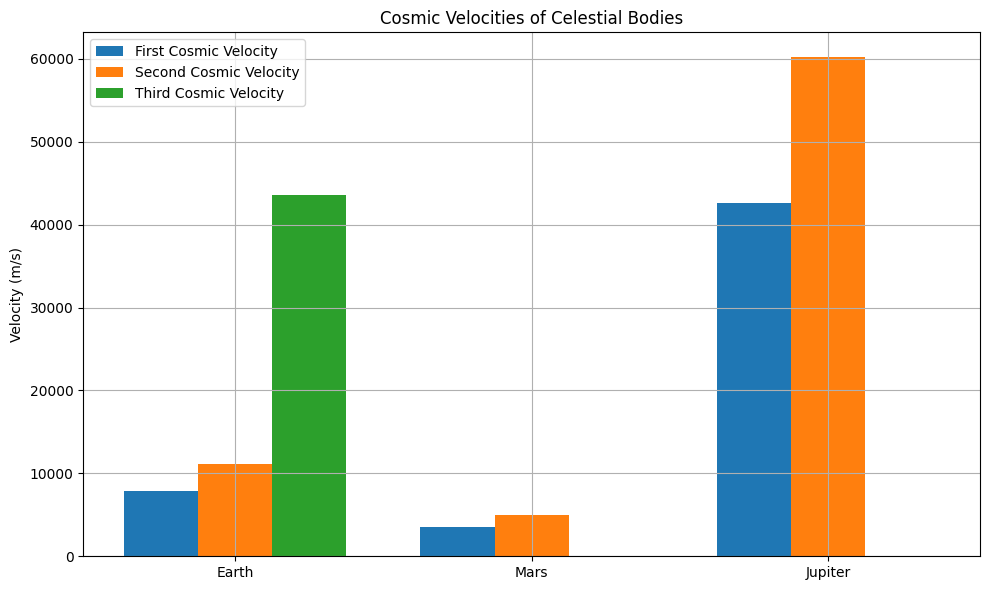
6. Comparison Table of Velocities
| Planet | First Cosmic Velocity (m/s) | Second Cosmic Velocity (m/s) | Third Cosmic Velocity (m/s) |
|---|---|---|---|
| Earth | ~7,910 | ~11,200 | ~16,700 |
| Mars | ~3,560 | ~5,030 | — |
| Jupiter | ~42,000 | ~59,500 | — |
7. Summary and Conclusion
Cosmic velocities form the cornerstones of astrodynamics. From satellite deployment to interstellar escape, mastering these thresholds allows us to: - Optimize fuel and propulsion. - Design effective launch strategies. - Explore the universe safely and efficiently.
As we aim for Mars colonization and exoplanet exploration, understanding and calculating these velocities remains as essential as ever.