Problem 1
Problem 1: Orbital Period and Orbital Radius
Derivation of Kepler's Third Law (Circular Orbits)
For a small body of mass \(m\) orbiting a much larger body of mass \(M\), we assume a circular orbit.
Newton's Law of Gravitation:
\(F_g = \frac{G M m}{r^2}\)
Centripetal Force:
\(F_c = \frac{m v^2}{r}\)
Set \( F_g = F_c \):
\(\frac{G M m}{r^2} = \frac{m v^2}{r}\)
Cancel \(m\), simplify:
\(v^2 = \frac{G M}{r}\)
Orbital period \(T\) is:
\(T = \frac{2\pi r}{v}\)
Substitute \(v\):
\(T = \frac{2\pi r}{\sqrt{\frac{G M}{r}}} = 2\pi \sqrt{\frac{r^3}{G M}}\)
Final Form (Kepler’s Third Law):
\(T^2 = \frac{4\pi^2}{G M} r^3\)
Implications for Astronomy
- Mass Calculations:
\(M = \frac{4\pi^2 r^3}{G T^2}\)
-
Planetary Distances: Given \(T\) and \(M\), solve for \(r\).
-
Satellite Design: Engineers use this to set satellite altitudes and periods (e.g., GPS, geostationary).
Real-World Example: Moon Around Earth
- \(r = 3.84 \times 10^8 \, \text{m}\)
- \(T = 2.36 \times 10^6 \, \text{s}\)
Use:
\(M = \frac{4\pi^2 r^3}{G T^2}\)
To compute Earth's mass.
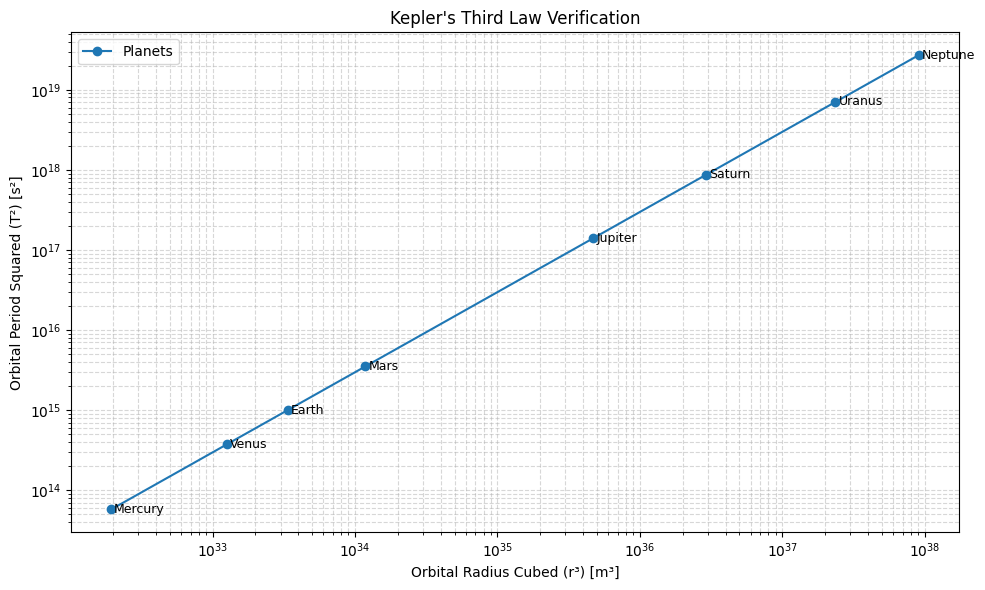
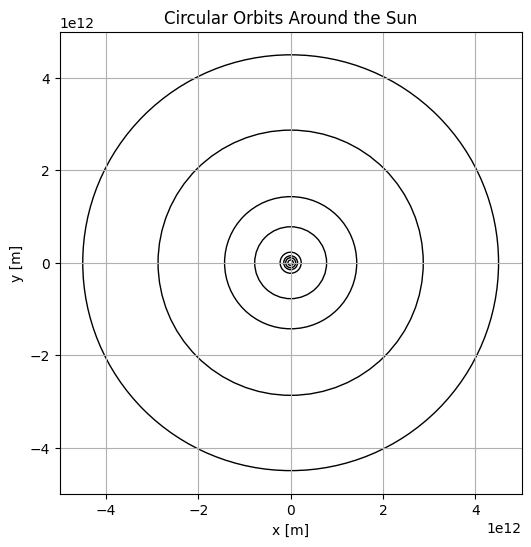
Extension to Elliptical Orbits
Kepler’s Third Law holds for elliptical orbits as well, where the orbital radius \(r\) is replaced by the semi-major axis \(a\):
\(T^2 \propto a^3\)
This means the square of the orbital period is proportional to the cube of the semi-major axis, even if the orbit is not a perfect circle.
This applies to:
- Elliptical planetary orbits (e.g., Mars, which has a noticeable eccentricity)
- Binary star systems, where two stars orbit their common center of mass
- Asteroids and comets, which often have highly eccentric elliptical orbits
The generalized form of Kepler’s Third Law becomes:
\(\frac{T^2}{a^3} = \frac{4\pi^2}{G(M_1 + M_2)}\)
Where: - \(T\) = orbital period - \(a\) = semi-major axis of the orbit - \(M_1\), \(M_2\) = masses of the two orbiting bodies